Tuesday, 28 July 2015

Special status of Jammu & Kashmir- (Dissecting the relevance of article 370)


                                                                                                                                                                         Source: Google

White Hat-Facts/ Figures
After the partition, Article 370 became a part of our constitution, granting autonomy to a state which feels muddled by the countries fighting for it.

Jammu & Kashmir is one such Indian state wherein Article 370 was firstly initiated. Reasons being, inclusion of plebiscite in the Instrument of Accession, reference of Kashmir to UN and Lumbered Indian defense.

Article 370 enabled Jammu & Kashmir to scorn all the decisions and laws enacted by the Parliament of India, apart from those in the field of defense, Foreign Policy and Communication, which are implemented in J & K after getting ratified by the state legislature of Jammu & Kashmir.

The article was formulated in late 1947 under the leadership of Sheikh Abdullah, the then PM of J & K as appointed by the Maharaja of the state and Pandit Jawaharlal Nehru, who being PM kept the entire portfolio with himself keeping Sardar Patel, the home minister, away from his statutory powers. 


According to Nehru, Article 370 was a temporary provision which would be removed from the constitution after a period of time as it was drafted in Amendment of the Constitution section, in Part XXI, under Temporary and Transitional Provisions.

J& K is not a state of homogeneous entity. Apart from area acquired by Muslims, Jammu is largely inhabited by Hindus, whereas Ladakh has a mix of Muslims & Buddhist citizens. Every citizen of India has only Indian citizenship, but citizens of J&K have dual citizenship. 

Anti-Defection Law is not applicable to J&K. Any outsider is barred from buying property in J&K state. Laws such as Gift Tax, Wealth Tax, Urban Land Ceiling Act and intermarriage with other Indian nationals are strictly prohibited in J&K State.

People's Democratic Party (PDP) led by Mehbooba Mufti brought in a law to annul the judgment by the court to introduce a “Permanent Residents (Disqualification) Bill” in 2004 which was also supported by Omar Abdullah's political party National Conference.


Yellow Hat-Optimism/Support

To have a debate or discussion on the issue of abrogating article 370 may not be a wrong thing to do but deep contemplation of how the decision might affect the valley is much needed before that.
If we look at the history then it becomes clear that the decision to accede to India was taken under pressure and even after National Conference took charge of the state, there were voices of protest coming from different parts of the state.
Tampering with autonomy of the state after more than 70 years of Independence would be like opening a Pandora’s Box which will revive the border issues with neighbouring Pakistan and China and also attract strong criticism from United Nations too.
There have been a number of myths regarding the state too. One such myth is that women of J&K lose their citizenship if they marry a non-resident of the state. However, in 2004 the state High Court had made clear that no such provision exists.
The most crucial concern while taking such a step is to understand that abrogating article 370 might give a push to separatist movement and lead to escalated violence in the state. AFSPA was passed in 1990 and is still continuing because of the problem of terrorism and to keep a check on the separatist movement.
Another reason which is provided is that the state is not developing fast because schemes of central government don’t reach. However, it is also true that the constitution provides power to president to amend the article and this has been repeatedly used. Currently, much of the schemes and developmental programs do reach the state.
About the restriction for non-residents of Kashmir to buy and own property in the state, a possible explanation can be that it helps in maintaining the beauty as well as safety of the place. Illegal establishments and rampant construction might breed a man-made disaster which has happened in other hill states.
Jammu and Kashmir is an integral part of India and it is also stated in Article 1 of the constitution of the state. The need is to focus on maintaining peace in the valley and also winning the trust of the people.

Black Hat-Criticism
The special status of J&K under article 370 of the Indian constitution has been a point of debate since decades. However, the times have changed and thus there is no harm in reconsidering it, so that ultimately the citizens of the state and India as a whole can benefit from such action. 
The special status to one particular state could evoke a feeling of the same status from other states that have seen major secessionist movements since the time of independence and that could create trouble for the union.
Article 370 gives autonomous status to the state of J&K and the Indian Parliament needs the State Government's concurrence for applying certain laws which completely disconnects the people of Kashmir from the Indian union.
Since article 370 was a temporary provision, delaying the decision to completely obliterate it from the constitution will only make it more difficult to do so in future. Hence, discussion regarding special status and its abrogation should be encouraged because it will only help for the betterment of the state.
The most crucial is controlling separatist elements and bringing peace to the valley which can only be made possible with social awareness and a feeling of oneness with the Indian nation. That would not be possible if the article 370 remains intact as a barrier between the state and the country to which it belongs.
The other point that can be considered here is that it will lead to social amalgamation and will open the doors mutual development as the tourism industry can easily flourish in the area. Also, full control in the hands of Indian government will ensure swift action against terrorist activities that will further help in catapulting the tourism trade.
The abrogation of article 370 and new provisions can bridge the gap between development and end the state of constant hassle under which the state has been for decades.
Just like the other states where people have a common identity; Jammu and Kashmir would have the same if the article is abrogated.

Green Hat- Creative Solutions
If we want to normalize the situation in Kashmir and want to bring harmony to the region, the Kashmir dispute will have to be resolved peacefully through a dialogue, keeping in mind the aspirations of the Kashmiri people.

The revival of economy in Kashmir in the current atmosphere of relative peace is essential. First, it helps to address some of the grievances of the people by engaging them in development projects, thereby further contributing to the peace process. Second, it helps reduce the chance of conflict resurging as poverty and unemployment are, among other factors, considered propellers of violence. Hence, it may prove not only costly but also imprudent to wait for the conflict to be settled fully and then to initiate process of economic development.

The opportunities, especially in the context of economic development, are enormous as the state is not only endowed with rich flora and fauna and scenic beauty, but also it has a past record of having a rich economy in the pre-independence era.

Tourism constitutes one of the main sources of income for vast sections of the Kashmiri population. Traditional Art and Handicrafts as Kashmiris are well adept at knitting and weaving can boost economy. Infrastructure growth is necessary, like having hydro-electricity project, improvement of connectivity in the region as the rail-road mix of transport in the state quite poor.

The need of the hour is to devise a logistic interpretation of the relevant clauses to the article, keeping in mind the intention of the framers of the constitution. By creating a provision for amendment, its framers never intended to bestow the operation of Constitution with absolute rigidity but to provide for a bit of flexibility to keep pace with the ever changing needs of the society and to serve the ends of justice.

Amendment of Article-370, as per the present circumstances is a myth as of now but this situation can be easily dealt with using logistic approach and can be very diplomatically modified to a reality.

 
Blue Hat- Expert Interview
Mr. Mushtaq Ul Haq, Associate Editor at ‘The Intellectuals’ and a renowned activist.

Q) Doesn't it make Kashmir look like not being a part of India, therefore gives separatists the right to claim that Kashmir is a free land?
A) Historically Kashmir was never a part of India. The idea of India was born in 1947 while Kashmir has much more older written history than any other Indian state. Under certain circumstances it acceded into India. Even if we believe that legally Kashmir is a part of India but Kashmiri people have never accepted accession treaty by their heart. Accession to India was supposed to be ratified by the people of Kashmir after 1947 which never happened.

Q) Is it not that article 370 is a non-issue to an average Kashmiri. Only political parties play around it?
A) I don’t think so. Article 370, for people of Kashmir, is the basis of their relationship (with India). It is the only link that connects J&K state with India. It grants them a special autonomous status which they will never give up. It gives them a sense of Identity.

Q) Abandoning Article 370 will strengthen economic and social development of J&K, Your thoughts?
A) India can invest in J&K without abandoning Article 370. Regarding social development, People of Kashmir are the most non-communal people in whole South Asia.

Q) If Kashmiris are the most non-communal people then why the Kashmiri militants grab the headlines everywhere? Social amalgamation, after abandoning Article 370, will reduce the threat of militancy.
A) How is communalism related to militancy? The Naxalites are fighting for certain cause, the Maoists are fighting for their interest. It’s media which gives it a communal angle. There may be a handful of people who are communal but overall Kashmiris are non communal and pluralistic. They don’t demand a separate Islamic state. They want the aspirations of an average Kashmiri shouldn’t be suppressed by the Indian Army. We have the highest concentration of army in J&K, the highest ratio in any part of the world. For a few hundred militants, do you need such a huge number of Army personnel? Militants have never used a communal card to meet their demands and you can witness the support for militancy when any of them is killed by army.  If any kashmiri is killed in a fake encounter, it helps reinforce  the Slogans of ‘Azaadi’, it’s because they feel oppressed.

Q) Indians from other parts cannot own land and settle in Kashmir. It sends wrong signals. Article 370 encourages separation.
A) There are many places in India in which most of the Indians can’t own land. That may be for environmental or topographical reasons like in Himachal, and political reasons too. You can’t visit Nagaland without a permit. So J&K is not an exception.

Q) A country should have one set of Laws and one constitution. Article 370 negates that.
A) Kashmir is different from the rest of India. I don’t think uniform set of laws will resolve the problems of Kashmir. Why should Kashmir be like other parts of India not the vice versa, where other parts will have more autonomy and there is more decentralization of power. 
Red Hat: Public Opinion
Rashid Ali, Kashmiri businessman living in Kolkata
Q) Kashmir is in a state of turmoil. Every now and then some negative elements wave the Pakistani and ISIS flags. Why is the situation deteriorating in the valley? 

A) There is nothing new about the situation. You need to understand that we Kashmiris have always been used by the two powerful nations, India and Pakistan. Repeatedly, our people are dying, either at the hands of Indian military or by the Pakistani terrorists. So the recent situation is quite natural as Kashmir wants to get relief from this uncertainty.
Q) Does supporting Pakistan or the ISIS seem to be a good solution?

A) The circumstances or the recent situation shows that the protest movement is supported by the separatist organization. We Kashmiris do not want any conflict, but we are frustrated because of India’s behaviour. I just want to say that whoever treats us better, we will be with them.
Q) Article 370 gives Kashmir a separate status. Do you think that the abolition of Article 370 and providing equal status will solve the situation?

A) No, the only solution would be to stop controlling Kashmiri people by extensive use of Army. We just demand to be left alone so that we can live in peace.
Archana Jaiswal, Student History (Hons), Calcutta University.
Q) Article 370; is it a curse for the people of Kashmir?

A) In my view, the government of India has no choice but to give Kashmir a separate status. Due to a status of special state, many Kashmiris feel that they are not Indian and it also gives an advantage to the separatists to motivate the youth into joining terrorist groups.
Q) Do you think that abolition of article 370 will normalize the situation in Kashmir?

A) I don’t think so, because the present situation in the valley is really disturbing. I think it is time that United Nations intervenes in the matter and tries to restore peace in the valley for the sake of Kashmiris.


======================================================================
Introduction


Namit Hans, Former Alumnus of IIMC, Sub editor at catchnews.com, @HansNamit

Ayaz Farooqui, Alumnus of IIMC, Works at ABP News (Editorial), @ayazfarooqui

Prateek Kumar, Alumnus of IIMC, Worked at Steria India ltd., Interned at Newsgram.com, Doordarshan, Freelance Writer, @kprateek35

Arnab Mitra, Alumnus of IIMC, Works at Newsgram.com

Erick Massey, Alumnus of IIMC, Interned at Delhi Press, Freelance Writer, @Masseyerick

Sanjay Kumar Bissoyi, Alumnus of IIMC, Columnist at Uday India, Orissa Post, @skbissoyee

Follow us on Twitter- https://twitter.com/nishpaqsh


Sunday, 15 February 2015

Manufacturing Terrorism- (Dissecting the face behind the guns)

Source: Google


White Hat- Facts and Figures
By- Namit Hans

Terrorism has been a major problem since long time. From common populace to the governments, everybody is talking about the ways to counter this problem. Every day we see newspapers covering one or the other terrorist attack in any part of the world. The attacks by Boko Haram in Nigeria and killings of journalists by ISIS are some of the latest issues of concern.

However, the controversy related to maligning a particular community and incognito powers who fund and encourage such acts are always a topic of debate. The perception that particular religion or countries are giving birth to terrorism is getting stronger. What is the reality and what is propaganda?

According to the Global Terrorism Database “terrorist attacks reached their twentieth century zenith in 1992 (with over 5,100 attacks worldwide), but had substantially declined in the years leading up to the 9/11 attacks. In fact, total attacks in 2000 (1,351) were at about the same level as total attacks in 1977 (1,307). Looking more broadly at overall trends, worldwide terrorist attacks through the mid-1970s were relatively infrequent, with fewer than 1,000 incidents each year.”

According to the same source, the top five terrorist organisations are Shining Path, Basque Fatherland and Freedom, Farabundo Marti National Liberation Fund, Irish Republican Army, Revolutionary Armed Forces of Columbia according to the frequency of attacks by them. Liberation Tigers of Talim Eelam (LTTE) comes eighth in the list with Taliban at thirteenth. However, LTTE comes at second and Al qaeda at third according to the number of fatalities.

The countries which suffer with such attacks most frequently are Combodia, Peru, El Salvador, India and Northern Ireland respectively. United States comes at twentieth position according to the frequency of attacks. But if we talk about the number of fatalities Iraq tops the list with Sri Lanka at the second position, followed by India and US comes at fifteenth position.

With the increase of terror attacks and the acts of killing in the name of counter terrorist, the world is being pushed into a war like situation. Who or what is actually responsible for it?


Yellow Hat- Optimism/Support
By- Ayaz Farooqi

What defines who is a terrorist and who is not?
Menachem Begin, the leader of the Jewish terrorist group Hagana, went on to become Prime Minister of Israel and received the Nobel Prize for peace. Contrary to this, Nelson Mandela while fighting the apartheid government was labeled as a terrorist and imprisoned for 25 years. So the equation is simple, whosoever is in the power, whatever label he gives, it gets stuck.

The terrorist organizations are designed to serve political and economic interests of states. The major recruiter of terrorists for the purpose of creating global hegemony happens to be the US. The US has a long history of supporting terrorists and using terror tactics. It was US who created Al Qaida and supported Osama in 1970s to fight the USSR.  As Naom Chomsky says “The U.S. is the world's leading terrorist state, and proud of it.”
The ISIS is its latest weapon that, much like Al Qaeda, is certainly backfiring. US is using ISIS in three ways: to attack its enemies in the Middle East, to serve as a pretext for U.S. military intervention abroad, and at home to foment a manufactured domestic threat, used to justify the unprecedented expansion of invasive domestic surveillance. Terrorism has become an excuse to justify mass surveillance, in preparation for mass revolt. 

Religion has never been the unique instigator of violence.  Avid followers and enemies of religions have acted throughout history in similarly brutal ways. Stalin guillotined hundreds of thousands of people, so did Hitler. According to FBI database among all the terrorists attacks committed on US soil from 1980 to 2005, the Latino extremists carried 42% terrorist attacks, Extreme left wing groups had hands in 24% terrorist attack whereas Islamic extremists are alleged to have conducted 6% of the total attacks. In Asia, The LTTE, one of the most notorious terrorist groups, has conducted hundreds of terrorist attacks. The IRA is another such example, they rein terror in UK. The list is endless where people get the motivation of spreading terror for sources other than religion.

This has been the policy of the west, specially the US to spread fear of religious extremism through the Media, among the nations as an excuse to fulfil their political and economic motives.


Black Hat- Criticism
By- Bhaswar Kumar

Aren’t terrorists simply tools in the hands of greater powers who use them to further their own goals? In today’s world there are many who pose this question so as to deflect the guilt from organizations and men who have butchered men and women alike under the pretext of some cause or the other.

Beyond the narrative and the counter-narrative lies the fact that these men, the likes of Osama and Kone, have taken the lives of thousands with little remorse in the pursuit of their own ideological or political goals. It is a fact of record that terrorists receive financial aid, weapons and training from interested parties. It is also true that often such organizations are used, with their consent or unwittingly, to further the geopolitical goals of nations and blocks. The Taliban is an example which illustrates this, the lynching, the targeted killing of the Hazaras and the draconian rules which the Taliban brought to the land were not executed under some American scheme. America was responsible for creating an environment which aided the Taliban but the greater blame lies on Mullah Omar who decided to exploit the environment to cease power through force.

This notion that terrorism is simply manufactured by world powers, in some clandestine factory and with the aim of enacting some sinister conspiracy ignores the fact that the roots of terrorism lie in intolerance and the willingness of many to use violence as a means towards their ends. The attempt to remove the religious factor from the actions of terrorists ignores the truth that stares us in the face. It is not the politics of a cause which manufactures the terrorist, most often it is the willingness to use violence supported by religious justification which makes the terrorist what he is. The youth who attacked Charlie Hebdo’s office were confidant in their belief that they were defending their faith and carrying out their religious duty, so were the perpetrators of 26/11.

We must open our eyes and realize that while geopolitics and the attraction of tools such as non-state actors do contribute in the spread of terrorist organizations, at the end of the day the ideology that drives them and the people who pull the trigger are products of these very organizations rather than being Indian, American or Israeli agents.


Green Hat- Creative Solution
By- Vibha Maru

If you go through the list of major terror attacks on Wikipedia the page seems to be a never ending one, and so are the casualties in it, incalculable people lost their lives in terrorist attack in the year 2014. Terrorism has innumerable faces in forms like Al-Qaeda. LTTE, RTE and even NDFB for that matter, they all share objectives oblivion in it self’s.

International politics seems like a bloody game of rugby where supreme powers like NATO use force to prevent ball from being dropped in their court, and when they confront each other it’s the ball that is squeezed under the human beehive. The BALL represents the world. If a common person goes through all those diction articles he might be able to understand that the well suited- mannered people, warming their comfortable seats in a secured environment are responsible for making the 3rd world what it is today.  

State sponsored terrorism must be regulated immediately; you cannot start a fire and expect it not to reach your states. There are 60 nations affected by terrorism today, still we see no unity in them. It was out in front that USA funded Al Queida but it never entered the genre of debates and discussions. Countries must differentiate their ideologies with their counterparts, US invasion killed 500000 people because they believed that Afghanistan was responsible for 9/11 attack, this marks no difference between them.

There is need for nations to understand the cost of proxy war fairness; underground or open, a war is a war, human lives are slaughtered both ways. The 4th estate on the other hand should be very cautious regarding its conduct in this fragile matter, being the primary source of information for common man, they must research and display pure facts rather than targeting a particular community.
Peace at ground level is also mandatory in order to do that mass awareness is imperative, so that youth share the liberty to make up their mind and not just be triggered as a pawn.


Blue Hat- Expert Interview
By- Ayaz Farooqi/Namit Hans

Abu Yahya Mansoor Danish, 8 year experience in Finance sector, member of advisory board Al-Iman Education Foundation, Delhi

Q1) Do you think religion is the supreme cause of terrorism? If not, then why do people have this belief?
Ans) It wrong to say that religion is a reason of terrorism. We had Virappan in India and there are Maoists, Ulfa, naxals etc. who do not have any religious reason of doing it. The same is happening on international level where terrorism is spread because of economic reasons where nations are attacking other nations. Rather, terrorism is a personal agenda where an individual is not able to convince people in a right way, therefore him or her adopts the wrong ways and starts terrorizing people.

Q2) There are certain conspiracy theories related to terrorism. Do you think these theories contain any truth or evidence?
Ans) Personally I am not for the conspiracy theories. These are good to sell on internet and it is a good means for several news channels to grow popular. If there are genuine evidences and proofs then it should be shared with the people. If the countries possess any information regarding such acts then they should share it openly with the public.

Q3) What are the urgent steps required to make people aware about all sides of this issue?
Ans) First of all, whenever something like this happens, people belonging to a particular religion (Islam) are expected to clarify their stand on the issue. This does not happen in other cases where people from other faiths are involved in it. It is foolish to blame a religion because of the act of a lunatic or a group of lunatics. The first step which is needed is that people, especially media, should start segregating terrorism with religion.

Q4) Do you think that there is media propaganda behind all of this?
Ans) Media in itself may not be doing propaganda but then the media can be used by those who are influential. However we cannot paint the entire media with the same brush and there are many media houses who are carrying out their jobs responsibly. The media should restrict itself to reporting facts. Media is one of the most powerful tools today and therefore if there is some propaganda then it shall be dealt by having more honest people in the profession.

Q5) Media relates terrorism with Islam and they have evidence of it, what do you want to say about it?
Ans) Who are the people benefiting the most when an act of terrorism happens? If you actually analyse, those who benefit the most are the ones who have economic interest. Therefore, if the media is reporting about one reason of terrorism, then they shall also concentrate on different perspectives too.


Red Hat- Public Opinion
By- Moumita Majumdar

Anubhab Sarkar,  Final semester Law student, KIIT

Q: Who according to you spreads terrorism?
A:  Psychologically, terrorism is just another term we hype up to intensify a cause. It is done by people like me and you, just with a psychologically dominated mind-set. There is a threshold for every human to stay within their human bounds. Once you cross that, the reason you cross that boundary for, becomes the sole purpose of your life. It is us, who witness ‘terrorism ‘occur and it is also us who maintain an agenda that a person with a beard is a terrorist.

Q: Is it religious fundamentalism that leads to terrorism?
A: Religious fundamentalism has at a point in time been the reason for the fail of every religion. Religious fundamentalism is a basic substitution of the word ‘fanaticism’. A religion will not permit us to kill children who go to school in order to get their 72 virgins once they die. Religions exist to make our thought processes cleaner, our beliefs stronger and our perspectives bolder.

Q: Do you think there are any hidden powers behind such organizations?
A: There are things we want to do and there are things we don’t want to do. I’m sure that depleting humanity should be the last thing that never should happen. Political agencies are known for their nexus with terrorist agencies. They are known to be state sponsored, party and belief sponsored. I don’t understand how communists can afford to hire terrorists. I’ll just leave it at that.


Srijita Bose, Student (Masters in English), Calcutta University

Q: Who according to you spreads terrorism?
A: Generally we say terrorism is spread by religious fundamentalists. It’s not always just that though. There can be political terrorism or state terrorism (what we know as rule of terror) etc. So it is hard to say who spreads terrorism. The concept of terrorism is itself controversial because it is often used by the state to legitimize their actions and maintain power. It is basically used by individuals and organizations to further their personal objectives.

Q: Is it religious fundamentalism that leads to terrorism?
A: Like I mentioned earlier, religious fundamentalism is one of the many types of terrorism. Definitely it has been creating massive havoc in our country in the late 20th and 21st century. But in a general discussion about terrorism, it is only right to include all the other forms as well.

Q: Do you think there are any hidden powers behind such organizations?
A: In case of religious fundamentalism, I don’t think the powers are hidden any longer. In fact the Talibans always claim their acts with pride. It’s a known fact that Lashkar-e-Taiba and Al Qaeda groups caused the Mumbai attack and the twin tower attacks respectively.


*******************************************************************************

Introduction:

Namit Hans, 23, Graduate in Economics from Delhi University, Former Gandhi Fellow at Piramal Foundation for Education Leadership, Pursuing Diploma in English Journalism from Indian Institute of Mass Communication, Dhenkanal

Bhaswar Kumar, 23, Graduate in English literature from Delhi University, Pursuing Diploma in English Journalism from Indian Institute of Mass Communication, Dhenkanal

Mohd. Ayaz Farooqui, 24, Graduation in computer application from Institute of management studies Ghaziabad, Worked for YES Roorkee,  Pursuing Diploma in English Journalism from Indian Institute of Mass Communication, Dhenkanal

Vibha Maru, 21, Graduate in B.Com (Hons.) from Rajasthan university, Pursuing Diploma in English Journalism from Indian Institute of Mass Communication, Dhenkanal

Moumita Majumdar, 22, Graduate in English literature from Calcutta University, Worked with Red Chillies Entertainment Pvt. Ltd., Pursuing Diploma in English Journalism from Indian Institute of Mass Communication, Dhenkanal

Like us on facebook Click Here

Saturday, 7 February 2015

Delhi Elections 2015- (Dissecting the Opportunistic Politics)

Source: Google


White Hat- Facts and Figures
By- Sanjay Kumar Bissoyi

The national capital election is always important for several reasons. 2013 assembly elections, when Aam Aadmi Party led by Arvind Kejriwal, a creation of Anna Hazare’s anti-corruption movement, trounced Congress; Sheila Dikshit herself was defeated by Kejriwal from New Delhi Assembly constituency.

Arvind Kejriwal formed the government with support of Congress; although he resigned within 49 days as he could not pass the Jan Lokpal Bill he had promised to the electorate. Kejriwal resigned on 14 February 2014 and since then the state is under President’s rule. Delhi Election got over on 7th February and now we are waiting for Result which will be announced on 10th.

BJP named former IPS officer Kiran Bedi as its CM candidate for upcoming Assembly elections. Equated to 2013’s three cornered Congress-BJP-AAP fight, this time fight is between BJP and AAP. BJP is now trying to run the show by producing a once Anna Hazare’s crusader on the dais against Kejriwal.

The Association for Democratic Reform data shows that 673 candidates from over 70 parties are contesting the election for 70 constituencies in Delhi. 230 (34 per cent) out of 673 candidates are crorepatis. 114 (17 per cent) out of 673 candidates have declared criminal cases against themselves. During the previous Delhi Assembly elections in 2013, out of 796 candidates analyzed, 130 (16 per cent) candidates had declared criminal cases against themselves. According Opinion Poll Result conducted by various news channels shows that AAP will emerge as victorious where 67 percent of voters’ turnout recorded. The Data also shows that the number of crorepati candidates has catapulted in AAP and BJP tops the list of candidates with most number of criminal cases against them.

Delhi has seen the governance of BJP that changed three CMs in its five year term and it also saw an AAP government of 49 days. Delhi has also seen a Congress CM that governed for three successive terms. Delhi voters now have decided who to choose; do they want stability and sustained good governance in their state or the empty rhetorical promises and opportunistic politics?


Yellow Hat- Optimism/Support
By- Saloni Saini

In the present scenario, the political setup of the national capital has been molded in such a manner that it lays great scope for political opportunism. But people often confound between opportunism and cynicism. Being a political opportunist is nothing but availing the opportunities that come in one’s way, without causing any societal harm.

BJP being the most powerful political party in the country at the moment couldn’t find an appropriate Delhi CM candidate. Thus they ‘parachuted’ Kiran Bedi, which was later termed as ‘gross political opportunism’ by Congress and ‘iconic political somersault and opportunism’ by AAP. In this case, BJP used Bedi’s immaculate image for projecting her as an ideal CM candidate, whereas the ever reluctant Kiran Bedi used this as a chance to enter politics with her most favored party. Furthermore, Barack Obama’s presence on Republic Day served as an election campaign opportunity for the saffron party. Hence, all parties tend to cash upon the opportunities that come in their way.

Former AAP member who recently went on to join BJP, Shazia Ilmi also held Kejriwal as being an opportunist. If for Kejriwal joining politics by means of forming AAP was opportunism, then Ilmi switching from AAP to the saffron party can also be dubbed as mere opportunism.

Several Congress members like Alka Lamba, Arvinder Singh Lovely (son of Congress leader Buta Singh) went on to swap parties in a quest for better political prospect. Individual candidates switch from one party to another; people from distinct professions join politics at the cost of their existing professions because this gives them a superior political chance.

There is nothing subpar in seizing the opportunities that come in one’s way. Rather opportunistic politics not only breaks the monopoly of the dominant political parties, it also provides the voters an array of options to choose from.


Black Hat- Criticism
By- Saba Fatmi

This phenomena of opportunism is not new in politics, it has been availed by politicos to gross their whims and wishes since ages and hoodwinking the masses. Currently the state of affairs hovering around the Delhi elections manifests “new age opportunism”. Every single party is fooling around analogously but claims to be poles apart from the other.

The deceitful attempts pursued by all the parties are in the fore, be it BJP, AAP or Congress; all are sailing on the same boat. From the very onset of their career, both Arvind Kejriwal and Kiran Bedi have been despising the arena of politics but as we know now they both are battling neck to neck for the same spot. We can very much say that India against Corruption movement of 2013 was the podium for many aspiring politicians to fulfill their desires and camouflaging it behind the welfare of the people.

The instances of switching off from one party to another also depict the very act of opportunism; wherever lion’s share is available they instantaneously get lured by it. Initially Kiran Bedi used to be a great critique of Narendra Modi and presently she can sing praises for him. She refused the offer from AAP to be a CM candidate for 2013 Delhi elections but accepted BJP’s proposal currently, what does this imply?

Arvind Kejriwal also showed erratic conduct within the span of his 49 days tenure as Delhi CM but committed a blunder by resigning from the post to stir his political career on the national platform of the general elections of 2014.

Apparently media acts as propagandist and fosters these politicos in proliferating their aspirations by duping the masses. But imperatively one thing should be kept clear-cut by these politicians in their brains that “masses are not asses” and the tables are turning around, public are becoming more aware and reciprocating to these beguiling deeds.


Green Hat- Creative Solutions
By- Erick Massey

The term opportunist, if labeled against a person may make or mar the credibility and potential in the virtual frame. It then enhances the chimera related to that individual which is not justified as the flow of thoughts and opinions is such that it emanates in a jiffy, so the reaction time is negligible to handle the little known ‘absolute’. So, there should be caution against certain words like ‘handle with care’ as a little misuse of that could then result in an epoch of uncertainties.

However, there is no denying the fact that there have been many opportunists collaborating, breaking bonds and reuniting here and there for personal gain.

So, sensible selection of candidates should be made keeping aside the face value and permanent selection for temporary gains for example, inclusion of Kiran Bedi against Kejriwal.

Opportunism is healthy if the intention favors the welfare of public, which we have seen under certain cases however that becomes tainted if a person exercises self-centered practices neglecting the latter.

So, equal balance should be made as the political ‘sand’ entraps the actual vision.
Hence, the media and people should make a sensible approach too in order to avoid over-hyping certain personalities as it becomes a catalyst for them to proceed. Instead, they should be welcomed with healthy criticism to prove their worth.

Delhi election is crucial and should be observed with vigilance. Yet another chance for a change which was observed erstwhile too and this can mark a healthy and strict response towards opportunists.


Blue Hat- Expert Interview
By- Srivatsan Nadadhur


Sanoj Gautam, Asst. Producer in NDTV, IT head of Patparganj BJP (Delhi)


Q.) What are your thoughts about the opportunists in today’s political scenario in Delhi?
Ans)  Opportunists will not be able to bell the cats because voters in Delhi are aware and they will certainly send them in a tight corner. For example, BJP will suffer a lot because of its parachute candidates like Vinod Kumar Binny.

Q.) Do you think that political parties have a role in vacating places for personal gains?
Ans) If any political party is doing it for development and growth than there is no harm in going for personal gains. It is a huge challenge to run any political party and no party can be always right.

Q.) Do you think it is all about Give and Take politics or there is more to it?
Ans) Giving and taking is a universal thing and I take it positively. In hung assembly, outcome is always negative so it is better to opt for alliance.

Q.) How this infusion of opportunistic politics is going to affect the people?
Ans) It has a negative impact on people. They don’t consider them as reliable and stable. They understand that opportunists aim at doing money business and most of the time they fail to deliver. However, I personally believe that the word opportunist is positive. If you get an opportunity, won’t you jump to grab it?


Red Hat- Public Opinion
By- Ankit Chatterjee

Vasu goel, student (BVP)

Q.)What do you have to say on the recent trend of opportunistic politics?
Ans) Opportunistic politics is the new dark phase of Indian politics. Opportunists, who don’t even know the real meaning of politics, try to govern over a state or a country. They just use their face value to bank in votes and major political parties use them as a mascot. We don’t even know with these people are eligible for such posts or not.

Q.)Is it generated by political parties or political ambitions of a person?
Ans) It is definitely created by the political ambitions of a person. Money, fame, post, retirement and career; they get everything.

Q.)What positive points can be gathered from that?
Ans) Positive thing about this trend is that people are getting options about the leaders they have to elect. Major parties are now corrupt and it gives an opportunity to new ambitious leaders to jump in and bring up the change.


Yogesh kumar, student (Delhi University)

Q.)What do you have to say on the recent trend of opportunistic politics?
Ans) This is not just a trend but mere a strategy from each party or an opportunist candidate.
This new 'trend' is intense and increasing every day. Delhi being at the centre has witnessed it in recent elections.

Q.)Does it always lead to a wrong candidate in power?
Ans) Not always, there have been some changes in the system in recent times. It has happened in Delhi too where some ambitious politicians came forward by using a few opportunities.

Q.)How does Delhi become a base for all such activities?
Ans) Well it is the centre to all the political activities so it is more intense in Delhi and a few other places too. The importance of Delhi is such that each party try to make its impact in any manner.


*********************************************************************************************
Introduction

Sanjay Kumar Bissoyi, 22, Graduate in Sociology from Behrampur University, Pursuing Diploma in Odiya Journalism from Indian Institute of Mass Communication, Dhenkanal

Saloni Saini, 23, Graduate in Mass Communication from GGSIP University Delhi, Former intern at Indo-Asian news Service and ABP news, Pursuing Diploma in English Journalism from Indian Institute of Mass Communication, Dhenkanal

Saba Fatmi, 22, Graduate in Economics from Jamia Milia Islamia Delhi, Pursuing Diploma in English Journalism from Indian Institute of Mass Communication, Dhenkanal

Erick Massey, 23, Graduate in B.Sc from Delhi University, Pursuing Diploma in English Journalism from Indian Institute of Mass Communication, Dhenkanal

Srivathsan Nadadhur, 23, Graduate in CSE from SNIST, Current film critic for CineGoer.com, Pursuing Diploma in English Journalism from Indian Institute of Mass Communication, Dhenkanal

Ankit Chatterjee, 22, Graduate in Journalism and Mass Communication from Amity University, Former Journalist at tadpoles.in, Pursuing Diploma in English Journalism from Indian Institute of Mass Communication, Dhenkanal


Like us on facebook: https://www.facebook.com/pages/Nishpaqsh/466230496850557?ref=aymt_homepage_panel

Follow us on twitter: https://twitter.com/nishpaqsh

Saturday, 31 January 2015

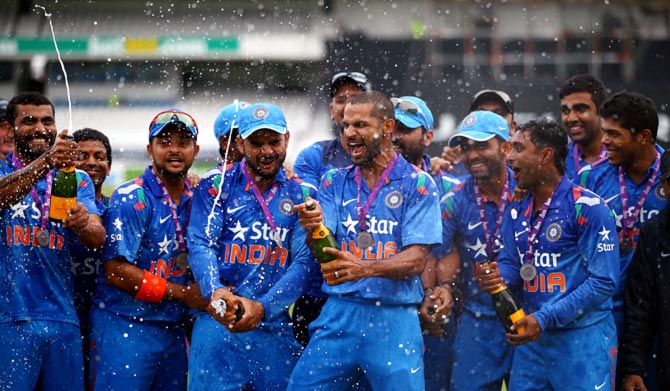
World Cup 2015- (Dissecting the Chances of Indian Team)

Source: rediff.com


White Hat- Facts and Figures
By- Erick Massey


The stage is all set for the biggest extravaganza in the world of cricket and yet again it is team India, One of the hot favorite team and the defending champions in the battle for the biggest title. The title ‘Defending champions’ is sufficient to explain the responsibility that the champions have.

We are aware of the fact that team India has done exceptionally well and there has always been that one player who has emerged in these battles as a savior for the team be it Yuvraj , Sachin , Sehwag or the captain cool dhoni but since it’s not a one-man show, all eyes are on the  entire batting and bowling department.

India has always been resilient which we have witnessed in previous world cup and other series and that is when a new start emerges with stupendous performance with the bat or with the ball.
The other thing is the record of certain players have been good in these fast and bouncy pitches that they will encounter in days to come but the other thing is the team now has been in that condition for a while now and is aware of all the odds and evens of these track.

The absence of experienced players like sachin, Yuvraj, Sehwag and Gambhir is a point of concern as it would be mere a gamble to just hit the field with new comers who have not been into such conditions much, so the nerves would be tight definitely, However the captain knows well how and when to use his resources which we have witnessed in his entire career which has been instrumental in the making of Kohli, Jadeja, Ashwin and Rohit Sharma.

The bowling department looks meek but once the ball starts swinging it is enough to take the stumps off the ground. The same has been the case with bowling and now we have a fresh spinner in the form of axar patel.

The temperament of the team is balanced with aggression and calmness in equal amount, attainment of which is enough to destruct the opposition.

  
Yellow Hat- Optimism/Support
By- Raza Naqvi


The performance of the Indian Team in the recently concluded Test Series does not inspire much confidence. The triangular series that is currently on was billed as one final opportunity to get used to the conditions in Australia in a format that the team is more suited to. However, the performance that has surfaced will worry the Indian fans, and concerns will be raised about the team’s competence to defend the world cup title.

The Achilles heel of the Indian Team has always been the extra bounce that is a common phenomenon on the Australian pitches. This new team has showed enough credentials to handle this enigma with aplomb, but then will this promise be translated into results. The solace that the team and the fans can garner is that India will play their matches in Sydney, Melbourne, Adelaide and Perth. The history of these venues can offer comfort to the batsmen, as apart from Perth, no other surface is conducive to too much bounce.

The sudden retirement of Mahendra Singh Dhoni from test cricket did raise many eyebrows, and many rumours were flying everywhere, speculating a rift in the team. He is back leading the team in one format he excels in, and the urge to prove his detractors wrong might instil in him one final push towards glory. Moreover, Sydney and Adelaide aid spinners and Dhoni becomes a different captain when it comes down to handling spinners. Expect a rejuvenated Dhoni, and this augurs well for the team.

The advantage that the team also carries is that it is not going into the competition as strong contenders considering the conditions, and this often pushes any team to scale that extra yard. All predictions and presumptions will cease once the team takes on the field, and this bunch of young Turks, have sown considerable mettle to fight on, and hopefully the fight becomes synonymous with victories. 
Bring home the cup boys!!!


Black Hat- Criticism
By- Manish Pathak


The defending champions are heading into the World Cup with a heavy cloud dangling over their head. The chance to defend their crown seems to be as frail, as the chances of searching a needle in a haystack.

The tag that the Indian team has carried for a long time now of being pussycats abroad has only assumed a more significant proportion considering the trail of disastrous performances the team has dished out in the recent past.
Even after spending close to three months in Australia, the failure to cope with genuine pace and bounce is a serious worry, and the application shown by the batsmen to rise and play the bouncing ball is also not very encouraging.

The bowling attack appears to be toothless. The lack of any genuine wicket taker, and also the infuriating tendency of the bowlers to present boundary hitting deliveries almost every over is appalling. Wickets have to be earned at the International level, and few good balls, followed by loose deliveries never allows pressure to be mounted on the batsman.  This has been a long tour, and the issue of burnout, particularly for the bowlers, is also a case for concern. Death bowling has always been the Achilles heel, and the trend the bowlers have been showcasing all but confirms the apathy for Mahendra Singh Dhoni.

Slip catching assumes great significance in conditions conducive to fast bowling, and this particular department does leave a lot to be desired. Catching in the slips is a specialized job, but the Indian team has played musical chair to allot positions, which has resulted in multiple catches being grassed.
Most of the teams, have almost settled into a team they will play in the World Cup. India meanwhile is still tinkering with their options. The extended lean trot of Shikhar Dhawan has created a gaping hole right at the beginning. Rohit Sharma has an injured hamstring, and the experiment to send Virat Kohli at number four, revels the humongous problems the team is facing at the cusp of a World Cup.
Barring Virat Kohli, R.Ashwin, Suresh Raina and MS Dhoni, no other player has the experience of playing in a World Cup. Lack of experience will impede the already flawed chances. Bowling remains the major worry, but the batting collapses and the inability to cope with genuine pace is also aggravating the concern.

Defending the Cup seems like a far-sighted dream, for there are too many question marks lingering, and the cupboard of answers is empty.


Green Hat- Creative Solutions
By- Sanjay Kumar Bissoyi


With the teams arriving the final phase of their planning for upcoming World Cup, defending champions India is one of the favorite to win the game's showpiece event. Back to back world cup win will be a nice mile stone for this young team.

No matter how strong teams like South Africa, Australia, England may be, with all their pace bowlers alternatives and bench strength, the Indian team, under MS Dhoni, has to show as always, like some trick roll up its sleeve, particularly in the one day international formats. He himself is one of the best finisher of world and strong leader in the shorter forms of the game, so he has to use full potential to win the title.

With one of the world's best limited overs batsman Kohli and captain like Dhoni together in the side, the batting looks very proficient. Players like Rohit, Raina and Rahane can always chip in with match-winning contributions and the concluding batsman already have enormous limited-overs capability and the performances too. With Ashwin and Jadeja, you have two players who can bat really well sometimes and not letting the opposition batters get away, most of the times. The pace department has to show consistently intimidating performance when we have bowlers like Yadav, Ishant, Shami and Bhubaneswar.  They have to read the pitches and bowl according to situation like using of bouncers, variation on pace etc.

Ground fielding is going to play a vital role in this world cup; youngsters like Jadeja, Binny and a couple more will enthuse the fielding department too, it will help the bowlers and become difficult to score for opponent batsman. We have to improve our slip catching technique, which is also an important factor in bouncy tracks, especially on pitch of Perth.


Blue Hat- Expert Interview
By- Namit Hans


Devang Gandhi, Former test cricketer, Commentator in on-going Ranaji trophy

Q.) What are the chances of Indian team in world cup 2015?

Ans) I think the team has a good chance. Let’s not go by what happened in the recently concluded series. It has been a long tour and I think players will get ample opportunity to regroup and refresh before the first match against Pakistan. I think it is a well-balanced side and they have to give a collective effort and it can’t be a one man show.

Q.) The team does not have any senior or experienced faces like Sachin or Yuvraj this time. How will this affect the team's performance?

Ans) I think Sachin’s retirement was already on the card and yuvraj has not been in a good form lately. Indian team has to come to terms with the fact that Sachin cannot be there in the team forever and also the team has won the champions trophy in his absence. They will definitely be missed but the team has moved on.

 Q.) Dhoni retired from test format recently which sparked controversy. Do you think it will affect his captaincy during the world cup?

Ans) I don’t think it will affect his captaincy at all because it was just one format which he did not want to play and so he retired from it. So far as the controversy goes, people will always speculate different things in our country and I don’t think it is going to bother Dhoni. In fact, his captaincy is going to be burden free and perhaps he will perform much better this time.

 Q.) Australian pitches are known for their bounce. Does Indian batting and balling line up have the capability to adapt to these situations?

Ans) The team has done well in the test series. Even though they did not do well in the one day series but playing against Australia is never easy. Also, the gap of four five days will give them a break from the game and they will be able to mentally adapt to the situation before the tournament starts. It is going to be a challenge of mental adaptation.

 Q.) Any personal comments or views? Please share.

Ans) They are the defending champions and the expectations are going to be high. As a former cricketer I can assure that the team will give its best to win.


Red Hat- Public Opinion
By- Prateek Kumar

 
Uma Banerjee, Student, Delhi University


Q.) What does world cup mean to you?

Ans) Living in country where cricket is transformed into a religion, people are waiting to see their team win and bring back the title. People have already started mentioning about cricket in their daily prayers. Hence not only me but the whole nation is waiting for India’s victory.

Q.) Who according to you is a better captain, Dhoni or Kohli?

Ans) Dhoni is good as a captain and Kholi as a player. The question of Dhoni’s retirement is popping up in media for quite a long time resulting in many controversies. But experience matters and you can’t choose Kholi over Dhoni as a captain. Maybe after world cup, but for the time being Dhoni is the only option.

Q.) Selectors chose young brigade over top guns. What according to you should be the ideal team?

Ans) The decision of including young guns in the team cannot be perceived as mere experimentation, it is the place earned by the promising young cricketers to face the fierce battle in the arena.


Sahil Kashyap, Writer, Mumbai

Q.) What according to you are the major advantages for the Indian team in upcoming world cup?

Ans) One of the biggest advantages that our team has is that they have been playing in Australia since the beginning of this year, so now they might be familiar with weather and pitch conditions which might help their bowlers to perform better.

Q.) Is the selected squad capable enough to defend the title?

Ans) While some might call it a gamble, the fact remains that the heroes of the world cup 2011 such as Yuvraj Singh, Gautam Gambhir, Harbhajan Singh, Virender Sehwag and Zaheer Khan have not been able to clear the acid test and could not make it to the final list. But still the caliber of selected players is good enough to play oversees and win the series.

Q.) What are your expectations from the team?

Ans) Indian selectors have chosen the best possible squad they could, even if it lacks experience. The team of 15 players is strong enough to tackle the situations and defend the title under the captaincy of M.S. Dhoni, ignoring the fact that masters like Yuvraj Singh and Virender Sehwag have been overlooked.


********************************************************************************

Introduction:

Erick Massey, 23, Graduate in B.Sc from Delhi University,  Pursuing Diploma in English Journalism from Indian Institute of Mass Communication, Dhenkanal

Raza Naqvi, 21, Graduate in Business Administration from Gauhati University, Former Journalist at Hindustan Times, Pursuing Diploma in English Journalism from Indian Institute of Mass Communication, Dhenkanal

Manish kumar Pathak, 23, Graduate in electronic engineering from Manipal Institute of Technology, Worked in Mitsubishi electric automotive India, Pursuing Diploma in English Journalism from Indian Institute of Mass Communication, Dhenkanal

Sanjay Kumar Bissoyi, 22, Graduate in Sociology from Behrampur University, Pursuing Diploma in Odiya Journalism from Indian Institute of Mass Communication, Dhenkanal

Namit Hans, 23, Graduate in Economics from Delhi University, Former Gandhi Fellow at Piramal Foundation for Education Leadership, Pursuing Diploma in English Journalism from Indian Institute of Mass Communication, Dhenkanal

Prateek Kumar, 23, Graduate in English Literature from Delhi University, Pursuing Diploma in English Journalism from Indian Institute of Mass Communication, Dhenkanal